


Quick Facts
- Status: Capital City of Kwara State
- Senatorial District: Kwara Central
- Traditional Ruler: Emir of Ilorin
- Current Emir: HRH Alhaji (Dr.) Ibrahim Sulu-Gambari, CFR
- Traditional Institution: Ilorin Emirate Council
- Major Local Government Areas: Ilorin West, Ilorin East, and Ilorin South
- Total Land Area: 765 square kilometers
- Indigenes of Ilorin: Ilorites
- Trademark Slang: Faa
- Population: Over 1 Million Residents (Metropolitan Area)
- Major Ethnic Groups: Yoruba, Fulani, Hausa, Nupe, Baruba, and Other Nigerian Communities
- Predominant Religion: Islam, with Significant Christian Population
- Widely Spoken Languages: Yoruba, Hausa, Fulfulde, Nupe, and Baruba
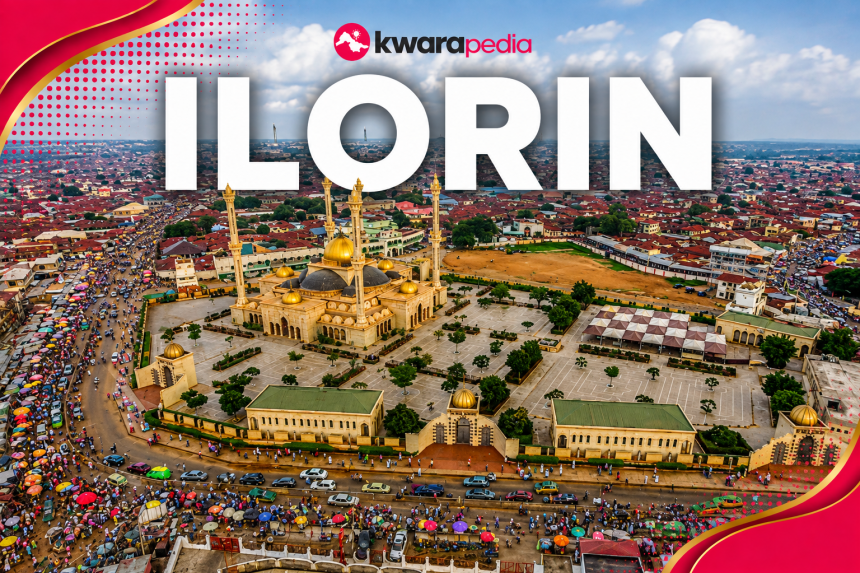
- Notable Landmark: Emir’s Palace, Ilorin Central Mosque, Sobi Hill
- Postal/Zip Code: 240101
Overview
Ilorin, the capital and largest city of Kwara State is a unique blend of history, scenery, and modernity, where religion is seamlessly intertwined with culture. Its place as primus-inter-pares in the assembly of Nigerian cities is unquestionable.
The name Ilorin derives from “Ilo irin” — meaning “sharpening metal” or “stone for sharpening metal” (Okuta Ilorin). The city was originally a frontier settlement where blacksmiths and ironworkers plied their trade, sharpening tools and weapons for hunters and warriors in the savanna region.
The city occupies a unique position as a meeting point between Northern and Southern Nigeria, blending Islamic, Yoruba, Fulani, Hausa, Nupe, Baruba, and other cultural influences into a distinct identity. Predominantly populated by Yoruba-speaking people, Ilorin is a cultural confluence with significant historical and cultural importance within Nigeria.
Often referred to as the “Gateway between the North and the South,” Ilorin is renowned for its rich history, religious heritage, traditional institutions, educational establishments, and peaceful coexistence among its diverse population.
Historical Background
Ilorin was originally a settlement founded by the Yoruba people. The name “Ilorin” is believed to derive from “Okuta ilo irin” meaning “stone for sharpening metals”.This name originates from a stone used by every farmer and hunter to fine-tune their metal tools (cutlass, hoe, and co). This peaceful period fostered the growth of a diverse community with strong Yoruba influence.
In the 15th century, Ilorin served as a military outpost for the Alaafin, the paramount ruler of the old Oyo empire (Oyo-Ile). For centuries, Ilorin served as a strategic frontier town, guarding the northern flank of the powerful Oyo. During the period, Ilorin was administered by Afonja, the sixth Are-Ona-Kakanfo (generalissimo) of the Oyo army and the successor of Are-Ona Oku of Jabata.
The 18th century marked a dramatic shift in Ilorin’s trajectory. Afonja, a powerful Yoruba warlord seeking autonomy from the Oyo Empire, joined forces with Shehu Alimi, a charismatic Fulani Islamic scholar. Together, they orchestrated a rebellion that ultimately led to the decline of Oyo’s influence in Ilorin.
After Afonja’s demise, Shehu Alimi and his followers, the Fulanis, assumed control of the city in the early 19th century. Shehu Alimi’s influence ushered in a period of Islamization, transforming Ilorin into a prominent Islamic center. A new political system with an Emir at the helm was introduced, a legacy that continues to this day.
British colonial forces took control around 1897–1900, incorporating Ilorin into the Northern Protectorate (later part of Nigeria). Ilorin became an important administrative center. The British maintained the emirate system under indirect rule, allowing traditional institutions to coexist with colonial administration. Post-independence, it became the capital of Kwara State in 1967.
Under the Emirship rule, Ilorin evolved into a significant Islamic hub. Grand mosques adorned the cityscape, and Islamic scholarship flourished. Despite this transformation, the city retained its Yoruba roots leading to a remarkable cultural fusion evident in its architecture, language, and social practices.
This blend of Yoruba and Fulani influences has shaped Ilorin’s unique cultural and religious landscape, defining the city’s character today. This cultural merging extends to cuisine, festivals, and everyday life, creating a vibrant and dynamic city. The city’s history reflects layers of Yoruba foundations, Fulani political influence, Islamic reform, and multi-ethnic integration.
Governance & Traditional Institution
The Ilorin Emirate Council
The Ilorin Emirate Council is a traditional institution and one of Nigeria’s most significant hybrid monarchies. It is a first-class emirate with a unique kingmaking tradition blending Yoruba and Fulani customs.
The Emir serves as the traditional ruler and custodian of the city’s cultural and religious heritage. The emirate consists of a network of district and village chiefs who assist in traditional administration. The current Emir continues a long line of rulers tracing their ancestry to Shehu Alimi.
Read More about: Ilorin Emirate Council