


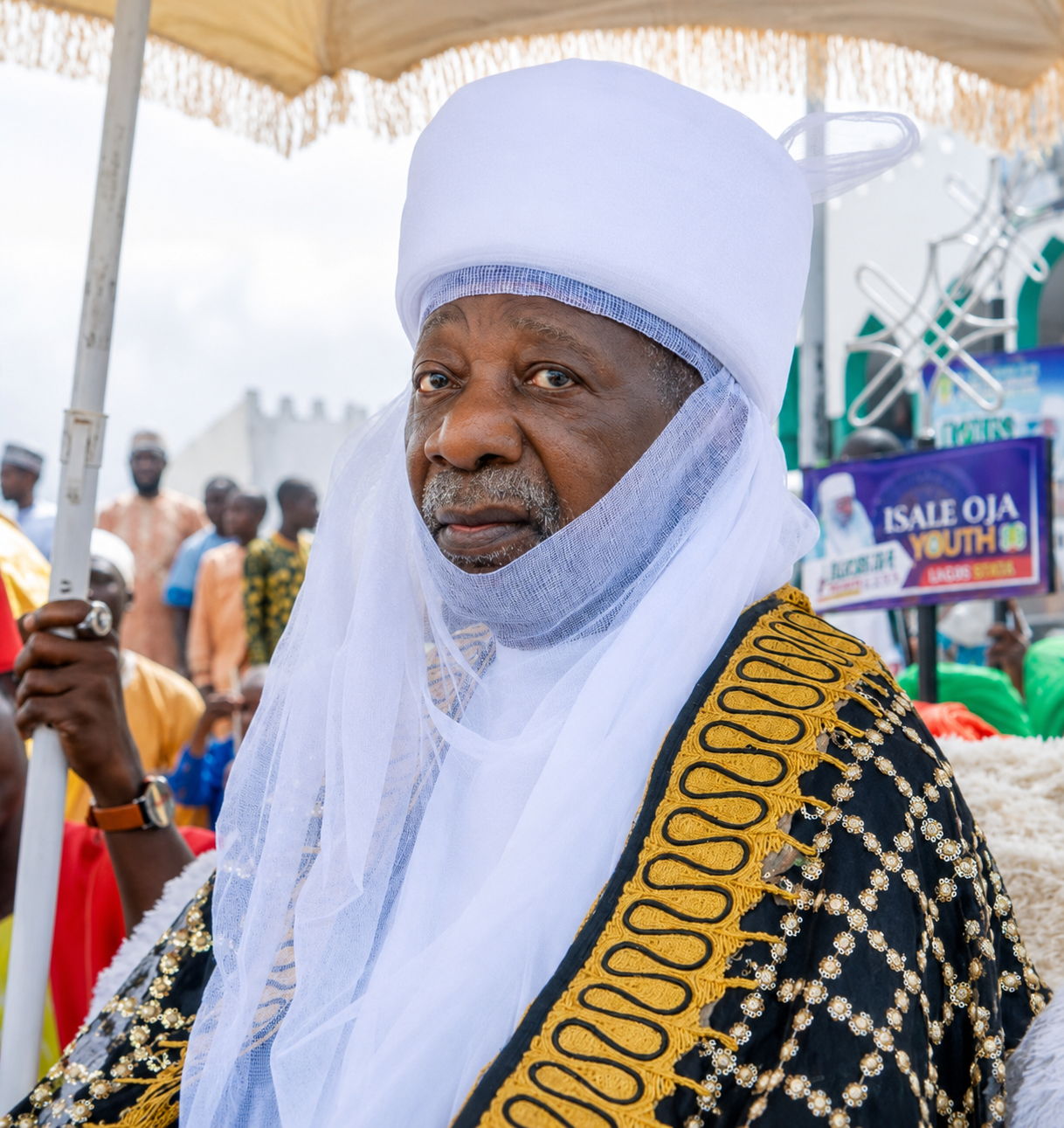
Quick Facts
- Full Name: Dr. Ibrahim Sulu-Gambari
- Royal Title: Emir of Ilorin Emirate
- Date of Ascension: 11 November 1995 (31 years, 0 months in reign)
- Class: First Class King
- Date of Birth: 22 April 1940 (Age 86)
- Profession: Jurist
- Former Position: Presiding Justice, Court of Appeal
- National Honour: Commander of the Order of the Federal Republic (CFR)
- Position/Office Held:
- Chairman Kwara State Traditional Council (Present)
- Chancellor Bayero University Kano (Present)
- Chancellor Muhammad Kamalud-deen University, Ilorin (Present)
- Chancellor Nnamdi Azikiwe University, Awka, Anambra (2001-2015)
- Chancellor Federal University of Agriculture, Makurdi, Benue (2015-2024)
Introduction
His Royal Highness, Alhaji (Dr.) Ibrahim Sulu-Gambari CFR, a direct descendant of the revered scholar, Sheikh Alimi, is the 11th Emir of Ilorin and permanent Chairman of Kwara State Traditional Council.
Born on April 22, 1940, in Ilorin. The HRH ascended the throne in 1995. However, before becoming Emir, he was turbaned with the influential title of Ciroma Ilorin in 1984, a common precursor among his peers in other emirates. He finally ascended the throne of his forebearers as the 11th Emir of Ilorin on August 28, 1995, and was coronated on November 11, 1995.
He is the son of the 9th Emir of Ilorin, Alhaji Muhammad Zulukarnain Gambari, CFR, and the maternal grandson of the 8th Emir, Sheikh Abdulkadir Shuaib Bawa, CBE. Through the lineage of Zubair Ayelabowo III, he is also a great-grandson of the 7th Emir, Shuaib Bawa (r. 1915-1919). A distinguished lawyer and jurist, he voluntarily relinquished his position as Presiding Justice of the Court of Appeal, Lagos Division, to assume his ancestral role as custodian of the Shehu Alimi dynasty.
Early Life and Education
Dr. Ibrahim is a direct and double descendant of Sheikh Alimi. His father, HRH Alhaji (Dr.) Zulukarnain Gambari (r. 1959-1992), was first a prince and later the 9th Emir, while his mother, Alhaja Aishat Nma Bolanta Sulu-Gambari, was a princess and the daughter of Shaykh Abdulkadir Shuaib Bawa, the 8th Emir of Ilorin (r. 1919-1959). The 11th Emir of Ilorin is the firstborn of his parents.
Though royal blood is his birthright, Sheikh Ibrahim’s educational qualifications distinguish him as a resourceful leader. His education began with Quranic studies at the age of 5 under Mallam Abdulsalam Audu Imale’s tutelage in Ilorin. He attended United Primary School, Ilorin, in 1947, and later Omu-Aran Native Authority School.
Thereafter, in 1957, he proceeded to Offa Grammar School for his secondary education before proceeding to Oakham, England four years after for the completion of his secondary education. In 1963, he obtained his A’ level certificate at the City Westminster College. In 1965, he obtained a degree in Law at the University of London and his LL.M. at the same institution in 1967. Within 1967 and 1968, he returned to Nigeria to attend the Nigerian Law School.
Judicial Career
Upon returning to Nigeria, Sheikh Ibrahim Sulu-Gambari trained at the Nigerian Law School in Lagos between 1967 and 1968 and was called to the bar in 1968. He undertook a year’s pupillage in the chambers of the renowned nationalist, Chief H. O. Davies, QC/SAN, before joining the civil service of the then North-Eastern State of Nigeria as a Substantive State Counsel in 1969.
In January 1975, he was promoted to Principal State Counsel Grade I. On March 16, 1976, he was appointed the first Solicitor-General and Permanent Secretary of the Ministry of Justice for the old Gongola State.
On January 1, 1977, he became an Acting Judge of the High Court for Bauchi, Borno, and Gongola States, making him the youngest judge in Nigeria at the time. A year later, he was confirmed as a Substantive Judge of the High Court of Borno State.
In recognition of his competent judicial service, Dr. Ibrahim Sulu-Gambari was promoted to Judge of the Court of Appeal in January 1983. He was posted to the Ibadan Division, where he served for eight years. In July 1991, he became the Presiding Judge of the Lagos Division of the Court of Appeal