

Overview
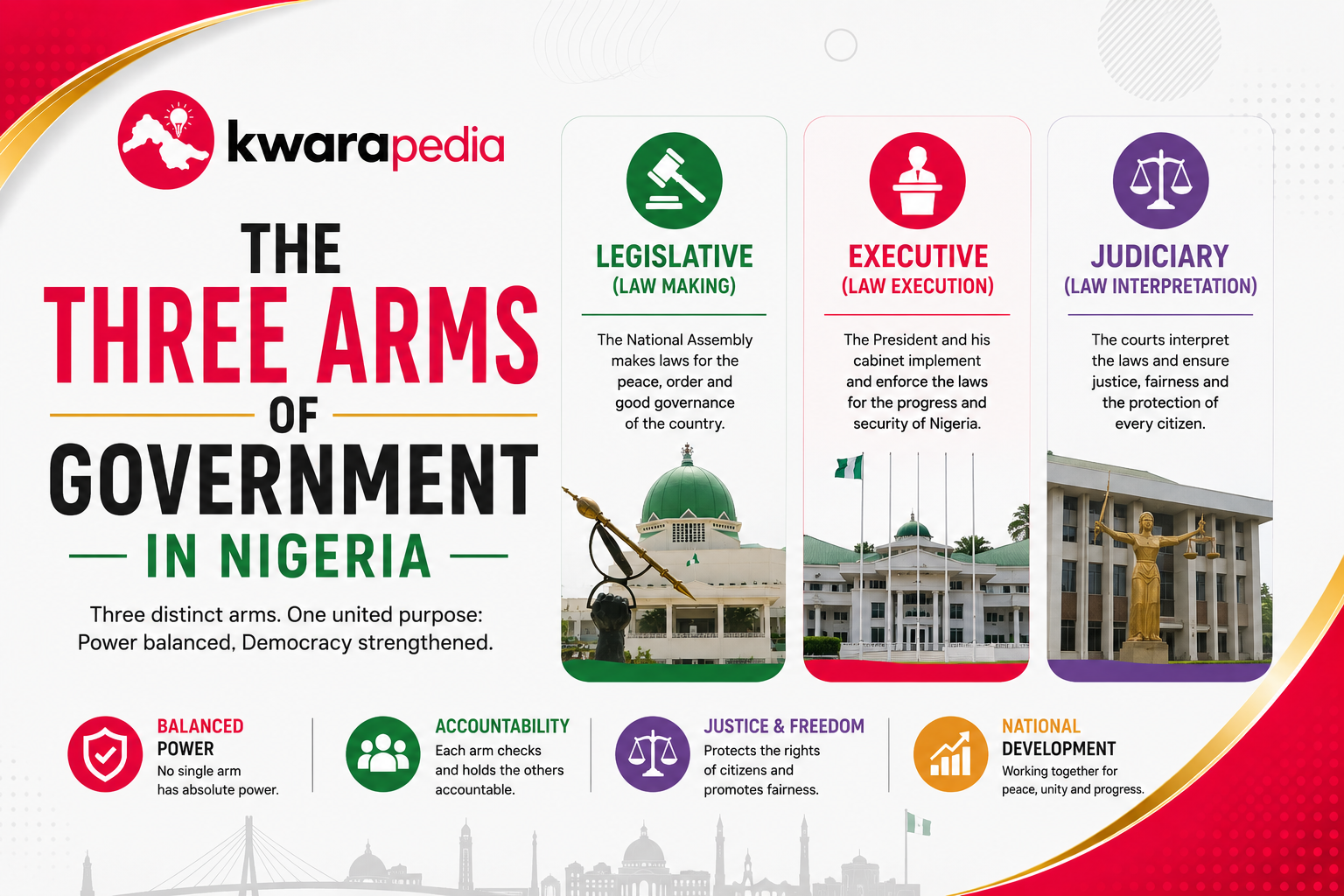
Nigeria operates a presidential system of government based on the principle of separation of powers, where governmental authority is shared among three independent but interrelated arms of government. This arrangement is designed to prevent the concentration of power in one institution and to promote accountability, transparency and the rule of law.
The three arms of government in Nigeria are the Executive, the Legislature and the Judiciary. Each arm has distinct constitutional responsibilities, but they work together to ensure the effective administration of the country.
Understanding the three arms of government is an important aspect of civic education and Nigerian general knowledge, as it helps citizens appreciate how public institutions function and how laws are made, implemented and interpreted.
What Are the Three Arms of Government?
The three arms of government are the three major branches through which governmental powers are exercised in Nigeria. They are:
- Executive
- Legislature
- Judiciary
Each arm performs different functions while serving as a check on the powers of the others.
The Executive
The Executive is responsible for implementing and enforcing the laws of the country. It is the administrative arm of government that formulates and executes public policies, manages government institutions and oversees the day-to-day administration of the nation.
At the federal level, the Executive is headed by the President, who serves as both the Head of State and Head of Government.
At the state level, the Executive is headed by the Governor, while at the Local Government level, it is headed by the Chairman.
Composition of the Executive
Federal Level
- President
- Vice President
- Ministers
- Secretary to the Government of the Federation
- Head of the Civil Service of the Federation
- Heads of Federal Ministries, Departments and Agencies (MDAs)
State Level
- Governor
- Deputy Governor
- Commissioners
- Secretary to the State Government
- Heads of State Ministries, Departments and Agencies
Local Government Level
- Chairman
- Vice Chairman
- Supervisory Councillors
- Heads of Local Government Departments
Functions of the Executive
The Executive performs several important responsibilities, including:
- Implementing and enforcing laws passed by the Legislature.
- Formulating and implementing government policies.
- Preparing and presenting annual budgets to the Legislature.
- Managing public resources and government institutions.
- Maintaining national security and public order through security agencies.
- Conducting foreign relations and diplomacy.
- Appointing public officials where authorised by law.
- Executing development programmes and public projects.
- Ensuring the day-to-day administration of government.
The Legislature
The Legislature is the law-making arm of government. It is responsible for making laws, representing the people and exercising oversight over the activities of the Executive.
At the federal level, the Legislature is known as the National Assembly, while states have State Houses of Assembly. At the Local Government level, legislative responsibilities are performed by the Local Government Legislative Council, made up of elected Councillors.