


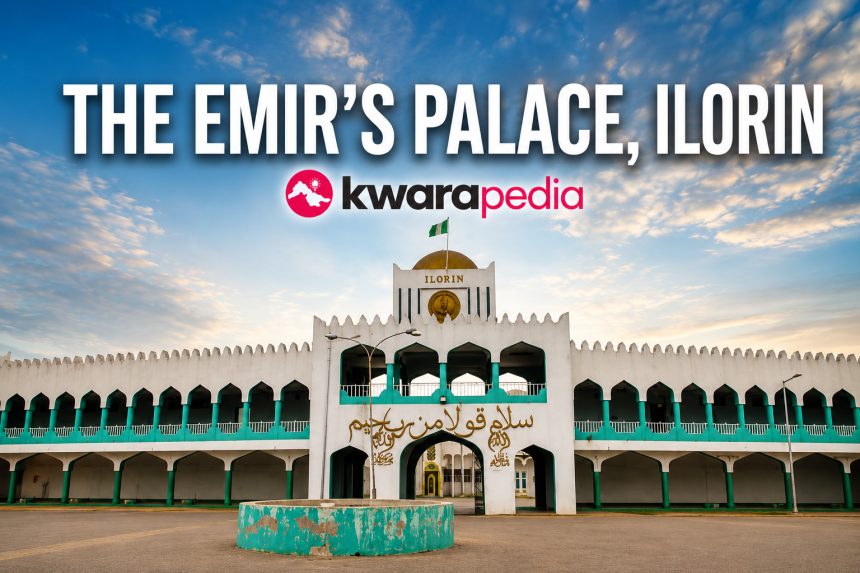
A Living Monument of Power, Faith, and Cultural Fusion
The Emir’s Palace (Gidan Emir) in Ilorin, Kwara State, Nigeria, is the official residence of the Emir of Ilorin and the administrative and cultural heart of the Ilorin Emirate. Situated in the historic core of the city, near landmarks like the Central Mosque, this sprawling complex is far more than a royal home, it is a living museum of Ilorin’s hybrid Yoruba-Fulani heritage, Islamic traditions, and political history.
From its ancient mosque older than modern Nigeria itself to its modern architectural additions, the palace complex tells the story of a city born from conquest, shaped by Islam, and sustained by a delicate balance of Yoruba, Fulani, and Hausa traditions.
For more than two centuries, the palace has stood as a symbol of leadership, continuity, and tradition, playing a central role in the administration, cultural life, and religious affairs of the Ilorin Emirate. Beyond its role as the residence of the Emir, the palace is a living institution that preserves the customs, values, and historical legacy of one of Nigeria’s most influential traditional kingdoms.
Historical Origins: From Yoruba Frontier to Islamic Emirate
The Pre-Emirate Era
Before the establishment of the emirate, the area that would become Ilorin was a frontier settlement within the Old Oyo Empire. The name “Ilorin” itself derives from “Ilo irin” meaning “sharpening metal” reflecting the area’s early association with blacksmithing and ironworking. The settlement was known as “Okuta Ilorin” (Stone for sharpening metal), a place where warriors and hunters would sharpen their weapons.
The earliest inhabitants were Yoruba settlers who established communities with their own traditional rulers and governance structures. Areas like Idi-Ape were the residence of Afonja, the powerful Are-Ona-Kankanfo (Field-Marshal) of the Oyo Empire’s army. However, the arrival of Sheikh Salih Ibn Janta, popularly known as Shehu Alimi, would forever alter the destiny of this settlement.
The Founding of the Emirate and the First Palace (c. 1823)
Shehu Alimi was a Fulani Islamic scholar, teacher, and spiritual counselor whose influence extended far beyond Yorubaland. His arrival attracted a diverse following of students, seekers of knowledge, and those drawn to his spiritual leadership. After his death, a power struggle ensued between the Yoruba forces loyal to Afonja and the Jama’a (Islamic community) led by Alimi’s descendants. The conflict culminated in the defeat of Afonja and the establishment of the Ilorin Emirate in 1823, with Abdulsalam—Shehu Alimi’s son becoming the first Emir.
The community established the first palace during this period and built it in the traditional Yoruba architectural style, featuring courtyards, clay and wood materials, and indigenous building techniques. However, with the transformation of Ilorin into an emirate under the Sokoto Caliphate (with authority vested in Gwandu), an Islamic architectural style adopted from the Hausa and Fulani peoples began to develop alongside the traditional Yoruba forms. This synthesis is still visible in the palace complex today.