


Quick Facts
- Senatorial District: Kwara South
- Region: Ibolo Land
- Traditional Ruler: The Olofa of Offa
- Current King: HRM Oba Mufutau Gbadamosi, Okikiola Ajagungbade I, Esuwoye II
- Traditional Institution: Olofa-in-Council
- Local Government Area: Offa
- Indigenes of Offa: Omo Olofamojo
- Nickname: Ijakadi Loro Offa (Wrestling is Our Game)
- Population: 120,000+ (projected growth)
- Predominant Ethnic Group: Yoruba (Ibolo subgroup)
- Primary Language: Yoruba (Offa dialect)
- Religion: Islam, Christianity, and Traditional Religion
- Major Festival: Onimoka Festival (Moremi)
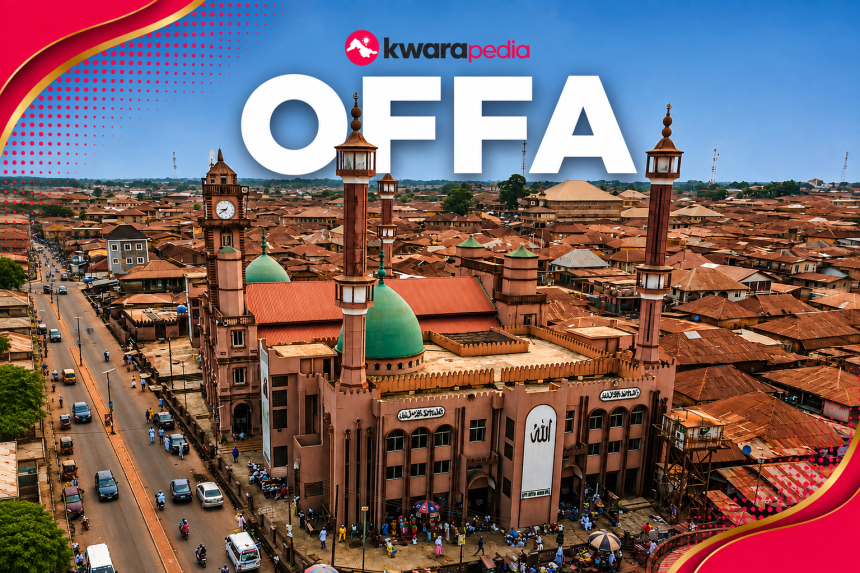
- Notable Landmark: Aafin Olofa, Offa Central Mosque
- Postal Code: 250101
- Area Code: 039
Overview
Offa is one of the most prominent ancient Yoruba towns in Kwara State, Nigeria, and serves as the headquarters of Offa Local Government Area. Located in the southern part of the state, Offa is widely recognized as a centre of commerce, education, culture, and entrepreneurship. The town occupies a strategic position on major road and rail routes linking Northern and Southern Nigeria, contributing significantly to its historical and economic importance.
Often referred to as the “Home of Sweet Potatoes” and celebrated through the popular praise saying “Ijakadi Loro Offa” (Wrestling is Our Game), Offa has maintained a strong cultural identity while evolving into one of Kwara State’s leading urban centres.
Historical Background
Offa emerged in the late 14th century, with traditional accounts placing its origins between AD 1000 and 1395, when Yoruba settlers established the town. Tradition identifies Olalomi Olofagangan, a warrior prince linked to the descendants of Oranyan from Ife/Oyo, as its progenitor. The name “Offa” derives from the Yoruba word for “arrow,” reflecting Olofagangan’s reputation as a skilled marksman and warrior.
The town played roles in regional trade, politics, and conflicts, including interactions with the Oyo Empire, Nupe invasions, Fulani wars, and the Jalumi War in the 19th century. It served as a railway terminus and administrative center under colonial rule, which boosted its growth. Offa has historical ties to other settlements like Offatedo in Osun State and Iyana Offa in Oyo State.
Governance & Traditional Institution
The Olofa of Offa
The town’s traditional ruler bears the title Olofa of Offa, one of the most respected traditional stools in Kwara State. He serves as the custodian of culture, tradition, and the spiritual wellbeing of the people. The Olofa is supported by Olofa-in-Council (a hierarchy of chiefs including the Essa, Ojomu, Sawo, Asalofa, and Balogun), who collectively help preserve the town’s customs and traditions. The palace of the Olofa is a significant cultural landmark and tourist attraction in the town.
Political Representation
Political representation in Offa is anchored within the Ifelodun/Offa/Oyun Federal Constituency of Kwara State and falls under the Kwara South Senatorial District.
Community Development
The Offa Descendants Union (ODU), founded in 1935, serves as a major socio-cultural organization promoting the town’s developmentthrough educational initiatives, healthcare support, infrastructure projects, and diaspora engagement. The organization remains one of the most influential community development associations in Nigeria.
Geography and Demographics
Offa lies approximately 58 kilometres south of Ilorin, the Kwara State capital. The town is surrounded by neighbouring communities such as Erin-Ile, Ijagbo, Igosun, Ipee, Ojoku, and Ilemona. The area falls within Nigeria’s Guinea Savannah vegetation belt, characterized by open grasslands and scattered trees suitable for agriculture.
Population estimates vary across sources, but Offa remains one of the largest urban centres in Kwara State, with a population exceeding 90,000 residents and a wider metropolitan influence extending across the Ibolo-speaking communities of Kwara and Osun States.
Economy
Agriculture has historically been the backbone of Offa’s economy. Farmers cultivate crops such as sweet potatoes, maize, cassava, yams, sorghum, and shea nuts, while trade in agricultural produce has contributed significantly to local prosperity. Offa serves as a collection and distribution centre for farm products from surrounding communities.
The town is also renowned for its traditional weaving and dyeing industry, particularly the use of locally produced indigo dyes. In addition, Offa hosts vibrant markets, including the famous Owode Market (a major 5-day market), which attracts traders from across Kwara State and neighbouring regions.
Over the years, the town has developed a reputation for entrepreneurship, producing notable busines