


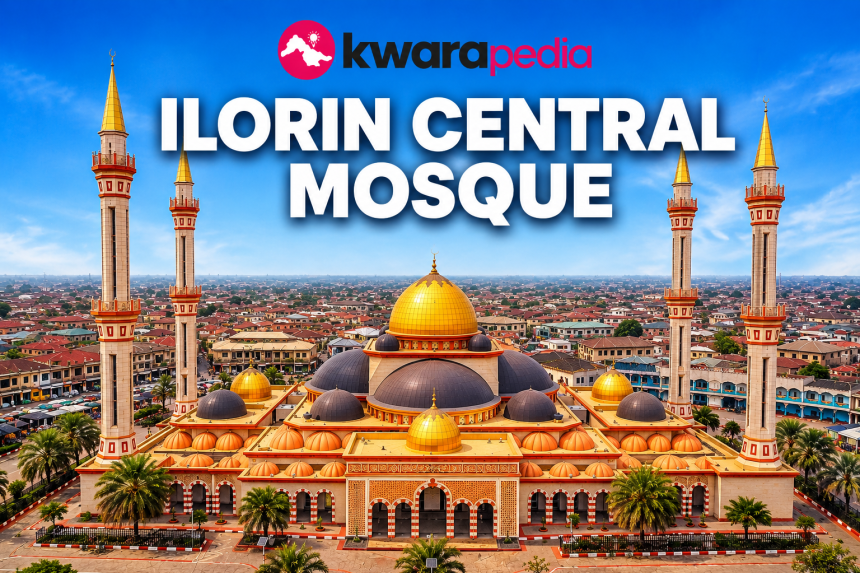
A Monument of Faith, Heritage, and Architectural Grandeur
Standing majestically in the heart of Ilorin, the capital of Kwara State in north-central Nigeria, the Ilorin Central Mosque (also known as the Ilorin Jummat Mosque) is far more than a place of worship. It is a towering symbol of Islamic heritage in West Africa, a testament to centuries of religious devotion, and a landmark that encapsulates the unique cultural synthesis of Yoruba, Fulani, and Hausa influences that define the Ilorin Emirate.
From its humble origins in the early 19th century to its current status as one of Nigeria’s most magnificent religious edifices, the mosque’s history mirrors the spiritual and political evolution of one of Africa’s most important Islamic centers.
Historical Background: The Roots of Islam in Ilorin
Early Settlement and the First Mosques
The history of Islam in Ilorin stretches back to at least the 17th century, with small Muslim settlements inhabiting areas like Oke Sunna even before the establishment of the emirate. In these early days, Muslims worshipped in open spaces demarcated by stones, sandy soil, potsherds, ropes, or thorny branches, often beneath the shade of natural trees, a practice common across Yorubaland. One of the earliest documented neighborhood mosques was the Agbarigidoma Mosque, established as an open-space mosque in 1741, followed by the Munambai Mosque in 1811. These modest structures reflected the grassroots nature of early Islamic practice in the region.
The First Central Mosque (1820)
The first official central mosque in Ilorin emerged in 1820 in the Agbarere Area, popularly known as Ile-Elewa, under the leadership of Sheikh Imam Muhammad Munab’bau. This development marked a pivotal moment in Ilorin’s history by formalizing the city’s role as a spiritual hub.
Fifteen years later, in 1835, Abdus-salam, the first Emir of Ilorin, oversaw the construction of a second central mosque at Idi-Ape. The Idi-Ape Mosque served as the city’s principal congregational mosque for more than a century. Over time, the mosque evolved from a simple mud-and-thatch structure into a more substantial building while retaining its indigenous architectural character, without minarets or domes.
The Idi-Ape Mosque served more than a religious purpose. Its location near the Emir’s Palace and Oja-Oba (Emir’s Market) placed it at the heart of Ilorin’s historic centre. Together, these landmarks formed a sacred triangle of religious, administrative, and commercial power that continues to shape the city’s historic centre.
The Birth of a New Icon: Construction of the Modern Mosque (1974–1981)
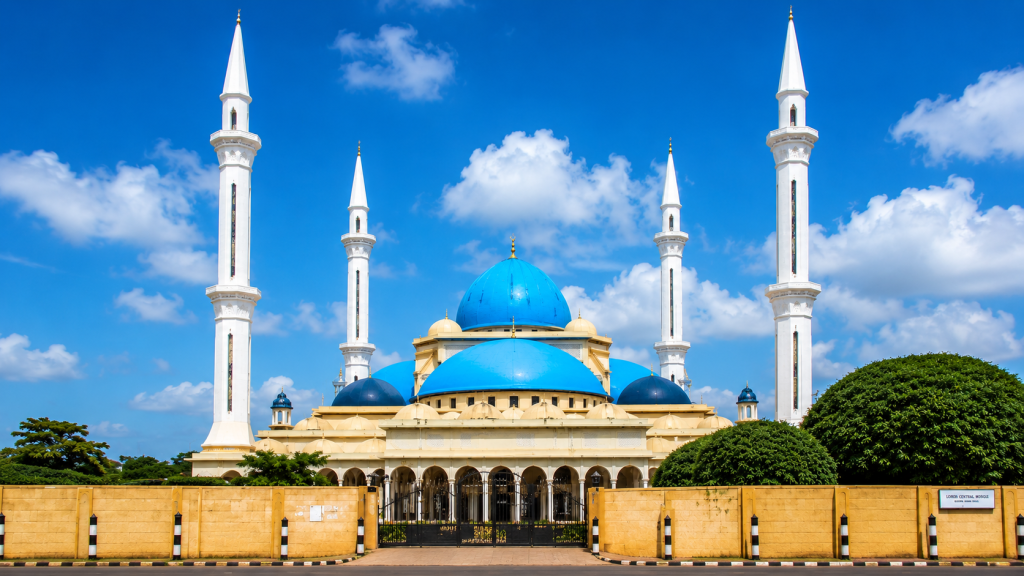
The Need for a New Era
By the mid-20th century, Ilorin’s Muslim population had grown exponentially, and the aging Idi-Ape Mosque could no longe