


Overview
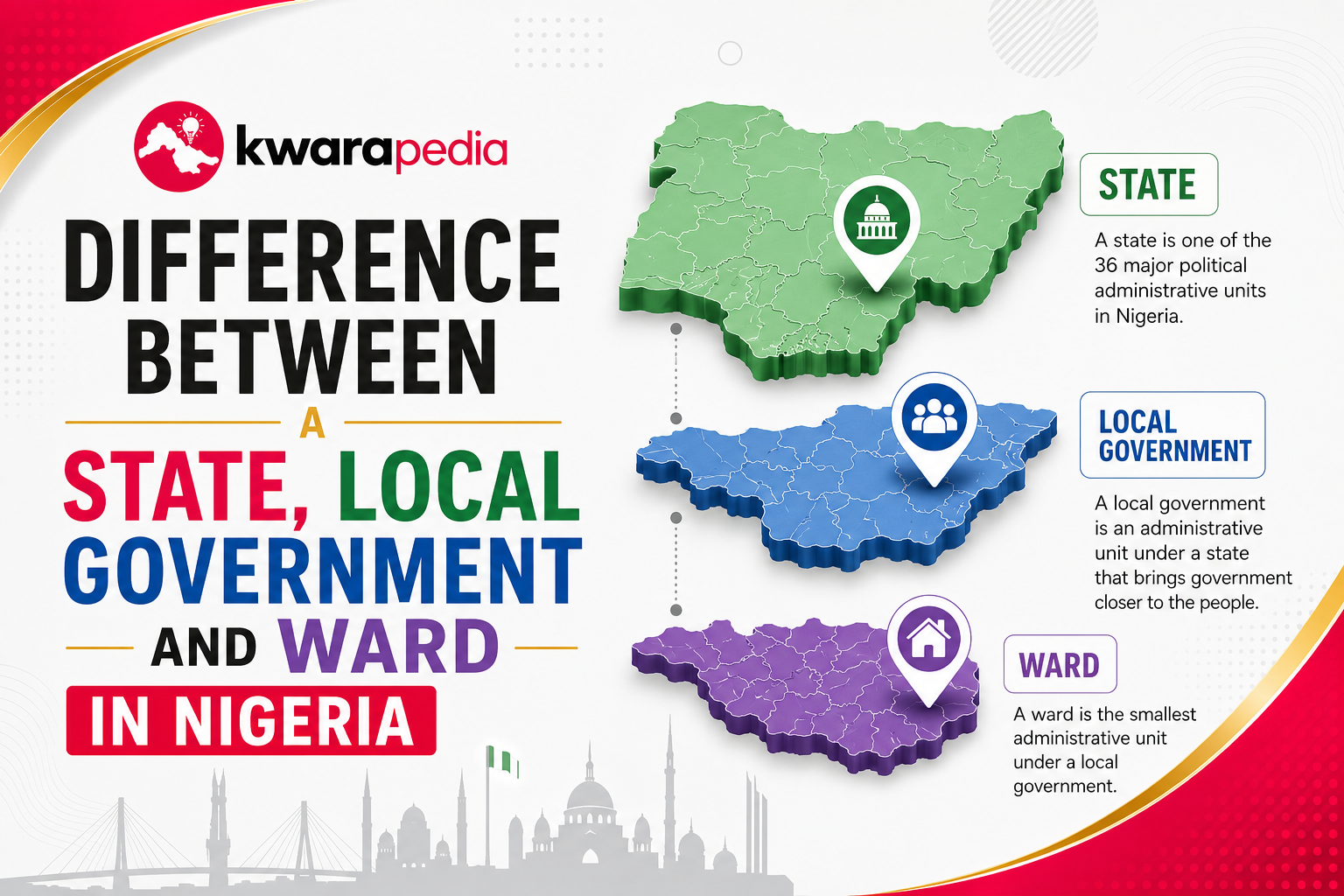
Nigeria operates a federal system of government with different administrative and political divisions designed to ensure effective governance and representation. Among the most commonly used divisions are States, Local Government Areas (LGAs), and Wards.
Although these terms are often used in everyday conversations, many people confuse their roles and functions. For example, a ward is sometimes mistaken for a Local Government Area, while a Local Government Area may be incorrectly referred to as a state.
Understanding the difference between a State, Local Government Area and Ward is important for civic education, elections, government administration, and accessing public services.
This article explains what each administrative unit is, how they relate to one another, and their roles in Nigeria’s system of government.
Nigeria’s Administrative Structure
Nigeria’s administrative divisions are organised in a hierarchical order:
- Federal Government
- States and the Federal Capital Territory (FCT)
- Local Government Areas (LGAs)
- Wards
- Polling Units
This means that every ward belongs to a Local Government Area, every Local Government Area belongs to a state (or the FCT), and every state forms part of the Federal Republic of Nigeria.
What Is a State?
A state is the highest subnational unit of government in Nigeria. Each of the 36 states has its own executive, legislature and judiciary, with powers defined by the Constitution of the Federal Republic of Nigeria.
Nigeria has:
- 36 states
- 1 Federal Capital Territory (FCT)
Each state has:
- A Governor
- A Deputy Governor
- A State House of Assembly
- Commissioners
- Ministries, Departments and Agencies (MDAs)
- State Judiciary
Functions of a State
State governments perform a wide range of responsibilities, including:
- Formulating and implementing state policies and development programmes.
- Enacting state laws through the State House of Assembly.
- Maint