


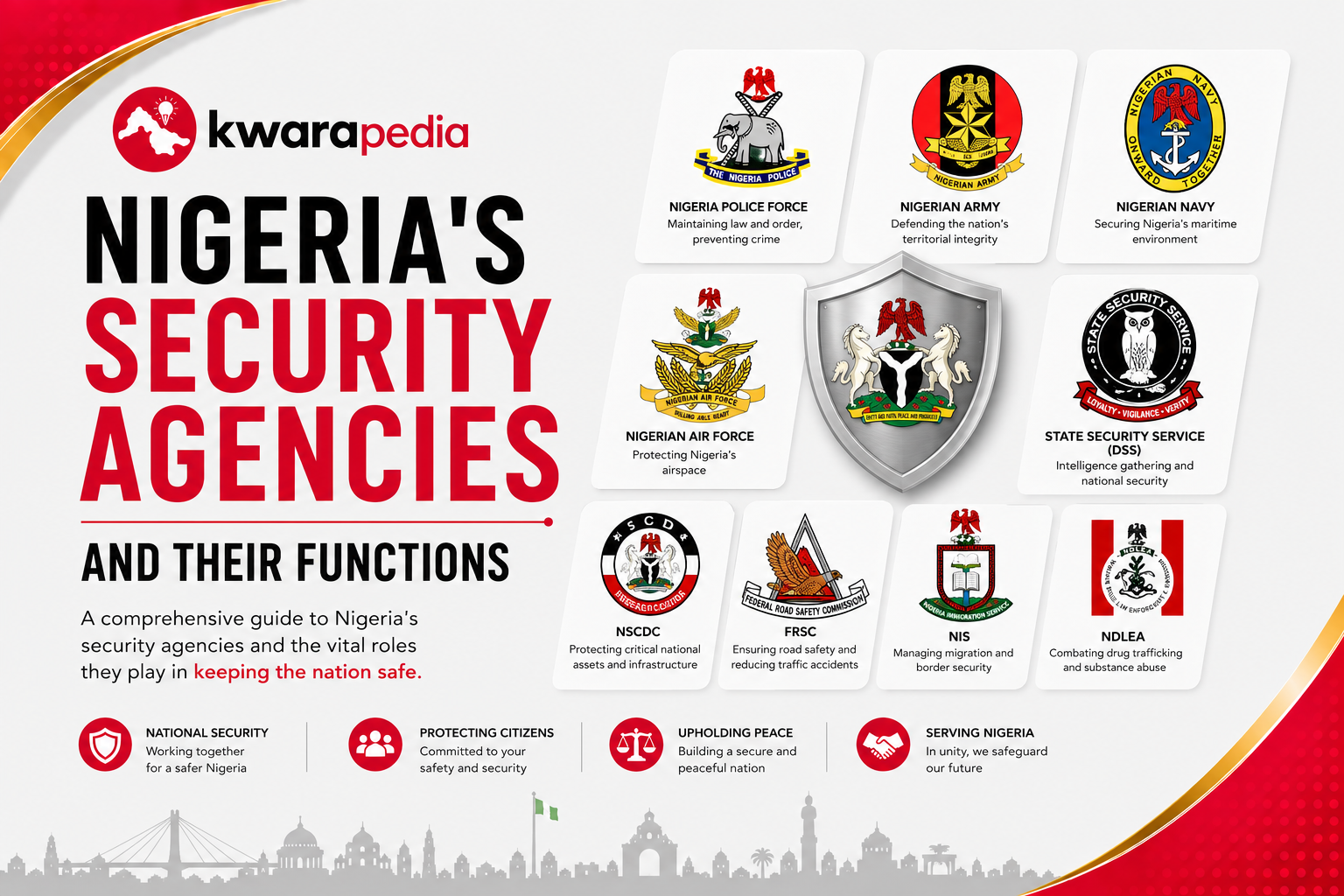
Overview
Nigeria’s security architecture comprises several government agencies responsible for maintaining law and order, protecting lives and property, safeguarding national sovereignty and enforcing various laws. While the Nigerian Armed Forces defend the country against external threats, other security agencies focus on internal security, law enforcement, intelligence gathering, border protection, anti-corruption efforts and emergency response.
Each security agency has a specific mandate established by the Constitution or an Act of the National Assembly. Although their duties may sometimes overlap, they work together to address security challenges, protect critical national assets and promote public safety.
Understanding the roles of Nigeria’s security agencies helps citizens know which agency to contact in different situations and provides insight into how the country’s security system operates.
What Are Security Agencies?
Security agencies are government institutions established to protect the nation, enforce laws, prevent crime, gather intelligence and respond to emergencies. They operate at the federal level, with many maintaining offices and commands across the 36 states and the Federal Capital Territory (FCT).
Intelligence Agencies in Nigeria
Nigeria has three principal intelligence agencies responsible for gathering intelligence, protecting national security, and supporting government decision-making. These agencies operate under different mandates covering domestic, foreign, and military intelligence.
1. Department of State Services (DSS)
Also known as the State Security Service (SSS), the Department of State Services (DSS) is Nigeria’s primary domestic intelligence agency. It was established in 1986 following the dissolution of the National Security Organization (NSO) and operates under the Office of the National Security Adviser.
Key Functions:
- Collects and analyses intelligence on domestic security threats, including terrorism, espionage, and sabotage.
- Conducts counterintelligence and counterterrorism operations within Nigeria.
- Protects the President, Vice President, Senate President, Speaker of the House of Representatives, state governors, and other designated public officials.
- Provides security for visiting foreign dignitaries and certain former presidents.
- Advises the Federal Government on matters relating to internal security and national stability.
2. National Intelligence Agency (NIA)
The National Intelligence Agency (NIA) is Nigeria’s foreign intelligence service. Originally established in 1977 and restructured in 1986, it is responsible for protecting Nigeria’s interests beyond its borders through intelligence gathering and international security cooperation.
Key Functions:
- Collects and analyses foreign intelligence relevant to Nigeria’s national interests.
- Conducts foreign counterintelligence and other authorised intelligence operations abroad.
- Monitors international terrorism, espionage, transnational crime, and other external security threats.
- Protects Nigerian citizens and strategic interests outside the country.
- Works with foreign intelligence and security agencies on international security matters.
3. Defence Intelligence Agency (DIA)
The Defence Intelligence Agency (DIA) is Nigeria’s military intelligence organisation. Established in 1986, it provides intellige