


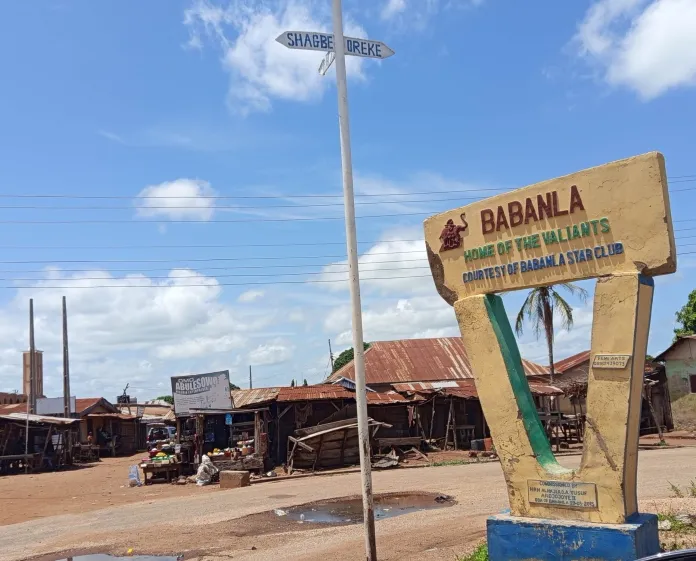
On the winding laterite road leading into Babanla, the landscape tells its own story long before any interview begins.
From Oke-ode, the asphalt remains relatively smooth, a quiet testament to government attention and ongoing road construction. However, we then encounter sections with fractures, potholes, and uneven stretches that slow every movement toward Shagbe and deeper into some communities in Ifelodun Local Government Area of Kwara State.
Yet, it is not the road alone that signals arrival into a troubled frontier — it is the security architecture that gradually unfolds.
At intervals along the route, vigilantes in mismatched uniforms, Nigeria Civil Defence operatives (NSCDC), and police personnel stand alert at makeshift checkpoints. Some lean on rifles, others scan passing vehicles with the strong and agile of men who have spent too many nights staring into forests that do not easily give up their secrets.
Further ahead, abandoned or partially deserted settlements break the rhythm of habitation. In some villages, only a handful of residents remain — elderly men seated under trees, women tending small farms, children peering cautiously at strangers.
Then, almost abruptly, life resumes. By the time Babanla appears in view, the contrast is unmistakable: a community that once slipped into silence is slowly rediscovering its voice.

A Child Under the Shea Tree
Under the wide shade of a shea butter tree overlooking the palace courtyard, young Lekan sits beside his mother, his small frame still and observant.
His attention is fixed on a tripod, a foreign object in his world — as my camera operator and I move around the dusty square of Babanla. He points at it excitedly, tugging at his mother’s wrapper.
For a child who should be thinking only of play, Lekan has already learned the language of absence.
Only months earlier, armed bandits stormed his community, forcing families into the bush, shutting down his school, and turning familiar paths into corridors of fear. The laughter that once defined childhood in Babanla vanished almost overnight.
Today, Lekan smiles again — but his story carries a weight no child should bear. His experience mirrors Babanla itself: a community learning, cautiously, how to breathe again.

Residents describe Babanla today as a place suspended between recovery and memory. Markets have reopened, though not at full strength. Children have begun returning to school. Farmers have resumed work on the outskirts, but the deeper forests once the lifeline of timber traders and hunters — remain largely inaccessible.
“We no longer sleep carelessly,” one resident says quietly. “There is patrol everywhere now — military, vigilantes, and our own people watching over us.”
The presence of security forces is visible at almost every turn. Military personnel have established operational bases in strategic locations, while local vigilantes and forest guards, trained and deployed by the Kwara State Government, maintain daily patrols along high-risk corridors.
The State Government, under Governor AbdulRahman AbdulRazaq, has expanded logistics support to security agencies, including mobility assets and coordination through relevant security structures at the state level, reinforcing joint operations across vulnerable communities. But despite the visible calm, the history still fresh in memory.
“They Came at Night” — The King